Translate

Saturday, April 5, 2014

How To Pitch Your Film’s Crowdfunding Campaign To Bloggers The Right Way...


If you're launching a crowdfunding campaign, it's likely you're going to try your hardest to get people like me to write, tweet, share, link, and donate to your film. Well, it's not as easy as it seems. I'm going to help you get publicity for your film the right way. ...

“As you probably already know, Kickstarter campaigns are all-or-nothing, so it’s going to take every bit of extra effort (and a lot of lost sleep) to get to the finish line.” – Ryan Koo, NoFilmSchool.com

I’ve never launched a Kickstarter campaign. I’ve never stressed over setting a financial goal. And I’ve definitely never even thought it would be possible for me to raise $125,000 like Ryan Koo did.
So, I know nothing about the emotional toll and exhilarating excitement that arises from running a crowdfunding campaign.

But I do know something about running a website.

And if you’re launching a crowdfunding campaign, it’s likely you’re going to try your hardest to get people like me to write, tweet, share, link, and donate to your film.

Well, it’s not as easy as it seems — you can’t just copy and paste a form email, send it off to some bloggers, and consider your work done. You’ll be lucky if you even get one response using that method.

Instead, I’m going to help you get publicity for your film the right way.

At least once a week I get an email from a filmmaker asking me to help publicize their Kickstarter or IndieGoGo campaign. While I’d love to help each and every one of those filmmakers reach their goals, most of the time these emails get quickly moved out of my inbox and into the digital ether for a variety of reasons:
  • The email was obviously cut and pasted from a template
  • Their pitch is unreadable because it’s full of grammatical errors
  • The email doesn’t specify how they expect me to help
  • The film simply doesn’t look interesting
  • And, most importantly, it’s irrelevant to the readers of this site (you!)
But let’s not limit it to email because social media is also an attention battleground for campaign donations. There’s also forums, website comment sections, and dozens more places online you can connect with other people.

No matter the digital platform you use, however, your message will remain the same: “pretty please help me raise enough money to make my film!”

So while a lot of what I talk about below will take its cue from email, don’t forget that many of these tips extend to wherever you’re broadcasting your message.

Polishing Your Email Pitch Into a Fine Diamond


What’s in a Name? Everything


Rule #1 is really simple: learn the name of whoever you’re contacting.

You’d be amazed at the number of people who email me through this site with salutations like, ”Hey Even,” “Dear The Black and Blue Team,” or, more commonly, no name at all.

This immediately sends up red-flags for me. Why?

Because it’s an obvious indication that you don’t read my site if you don’t get my name right! My name is plastered everywhere — on the footer of every page, in the byline and at the bottom of every post, and prominently in the about page — so it’s very easy to find out I run this site and do so by myself.

It’s not that I’m an egomaniac and need people to know my name, it just lets me know who actually reads my site (or at least took the time to find out who writes it).

So, that should be the first thing you do: find out who’s in charge.


Having the first name of this person is extremely valuable, especially if it’s hard to find. The harder it is to find, the greater the effect of using it will have. Using a name in an email has two positive impacts:

1. It personalizes the email

You will establish a small connection immediately in your first contact with the person. Think about it: when you hear your name in public, what’s the first thing you do? You look around, react, and maybe even respond. Names will attach the person you’re writing to to your message. And, at the very least, it gets their attention.

2. It tells them you’ve done your research

Like I mentioned above, using my name in an email lets me know you’ve taken a moment to scope out my site, if not read a few articles. If the name of the person you’re pitching to is hard to find, this effect increases because they will be caught off-guard that you know their name. They may think you already have a connection with them somehow.

There is, of course, one caveat to using a name — you better make sure you’re right.

Nothing will turn someone off from an email more than it being addressed to the wrong person, even if it is relevant and interesting to them. It makes a terrible first impression (I bet you still remember grade-school teachers who butchered your name) and you can’t afford to lose that ground.

If you can’t find any name, do your best to personalize the message in some way. Has the blogger ever revealed a nickname? What do their social media accounts say? How do they refer to their own site (or readers refer to it)?

The point is to establish a rapport from the very beginning of your email as if to say, “I know who you are and I’m not going to waste your time.”

Don’t Be a Stranger Either — Make an Impression with Who You Are


Anonymity has no place in your campaign. Who you are and what you have done will be crucial for those deciding to donate, but also for those who are considering publicly supporting your film.

Basically, bloggers want to know why you deserve to be featured on their website. By supporting your project on their blog, they will be putting a slice of their reputation alongside yours and want to make sure their status remains untainted.

So one of the first things you should do in your message is provide a brief introduction to yourself. Make mention of your name, what you do, and any history you have that is relevant to getting your film financed — accolades and awards are great to include.

Here’s an example:
My name is [Your Name] and I’m a [filmmaker, producer, director]. I’ve made over X short films and I’m working to shoot my first feature film.

Do your best to prove you’re a professional or an authority when it comes to filmmaking. Make your introduction ease any skepticism the blogger might have that you don’t know what you’re doing. If you have no authority or are new to filmmaking, use the introduction to provide an example of your passion for film or state what makes you notable as a newcomer.

Lastly, be brief. The message is about the film and its campaign, not you.

Become BFF’s and Go on Digital Dates


OK, so maybe the idea of a “digital date” is a little too much, but the premise of becoming BFF’s with the blogger (best friends forever, for those of you who grew up without text messaging) isn’t very farfetched.

And the idea of it shouldn’t be very new to you as a filmmaker — it’s nothing more than online networking.

Whether you direct, produce, crew below the line, or star in front of the camera, you will have been through this rodeo before. Networking is an essential part of being successful in the film industry and that mantra doesn’t get thrown out the window in the digital realm.

I’ve said it before, but it still holds true: networking is simply becoming good friends with people who can help your career.

So the BFF thing isn’t as ridiculous as it sounds, is it?

But how do you become BFF’s with a blogger?

You interact with them, you talk to them, you send them emails, you basically do anything you would do with someone in real life and translate that to the digital world.

Sometimes bloggers — especially the big ones — will seem inaccessible because of the mass of their audience, but I promise they take more notice than you perhaps realize. For instance, over the years I’ve run The Black and Blue, I’ve come to know many of my readers through their comments and our interactions online. I’ve even learned their tendencies and passions (like FB who will probably be the last person on Earth to give up film).

My point is that if you comment on posts, retweet their articles, and send them emails, bloggers are going to much more receptive to your requests. Maybe they won’t immediately take notice or even mention it to you, but when you email them, there is a strong possibility they will recognize your name.

And if you get to a friendly level with them before your crowdfunding campaign, it’s even easier to get them on your side because they’ll know you aren’t just using them.

It’s akin to the guy who wins the lottery and suddenly has to deal with forgotten friends who want loans — he’s much more likely to give money to the people who were friends with him before he struck gold. Blogs may not be the lottery (far from it judging by my bank account), but they do lend a certain type of notoriety and this minor celebrity status can make bloggers skeptical towards all those who approach them.

If you can’t capitalize on the friendship this time around or you haven’t quite gotten there yet, there’s always later on in your career. Even if you never run another crowdfunding campaign, networking with people who have a voice and the support of a community is smart.

Finally, it’s important to note this tactic takes time — you can’t rush a relationship with somebody in a week and then pitch them a project. You can try, but your ability to successfully network will be directly tied to the amount of time you’ve already invested.

Let Your Film Carry the Pitch


In a guest post I did on NoFilmSchool, I wrote about the importance of having a strong film when it comes to getting a crew to work for free:
That’s why it’s silly to see a crew call that advertises “will be submitting to Sundance” and a chance to “be part of something big.” Everybody submits to Sundance and everybody thinks they’re part of something big, but the odds of getting in Sundance are small and the odds of being something big are even smaller.
So what makes you different? Claims like that only increase skepticism and, worse, these listings rarely describe what the film is about.
If you really want a crew to work for free, pitch them the project and not the results. If you really do have the next big thing, it should be an easy sell.
The idea behind this — to pitch the project, not the results — holds true here as well.
Don’t focus so much on how your film is great, what you’re going to do with it, and the fame and riches that are guaranteed to come. Focus solely on the film itself, why the film is great, and why it needs to be made.

In this sense, your pitch will be a soft sell. That’s OK. Subtlety goes a long way. You aren’t trying to sell the blogger a new car insurance policy.

Ultimately, the soft sell works because it requires thought — the blogger, if they’re intrigued, will have the idea of your movie on their mind for awhile. With sleazy ”HEY LOOK AT THIS” tactics, they’ll quickly turn you down as soon as they can.

Don’t give them that chance.

Be reasonable and tell them about the story — that’s why people love movies, not because of awards.

Don’t Expect Free Publicity — How Can You Help?


One of the top rules when pitching anybody anything is to answer this very, very important question:
 
“What’s in it for them?”

Oblidge them with an answer before they even ask.

On the surface it may sound selfish, but bloggers want to know what benefit they have to post your film. It’s a question I’m constantly wondering when I get an email about a Kickstarter campaign.

It doesn’t matter if your reason is weak or obvious (i.e. it’s a great cause to support!) just answer the damn question!

But before you think about answering that question, perhaps it’s more prudent to answer this variation:
 
“What’s in it for their readers?”

To a successful blogger, readers and their eyeballs mean everything. This encompasses their entire audience from site readers to email subscribers to social media followers and anyone else under their online umbrella. Their audience is what gives them their platform, their voice, and ultimately, pays them a bit of cash. Their goal is to provide their readers with content that they enjoy — in various ways — so their website can continue to grow.

This question is often overlooked because you stumble on a site, it seems related to filmmaking, and you blast off an email.

But knowing who the audience of a site is helps immensely because if the blogger has a loyal community, they’re going to be protective of it. When you tell them why they should care about your project, the blogger is going to ask themselves why their audience would care. Sometimes, they don’t
find an answer.

So your job is to provide an answer for them. Tell them exactly why your campaign would be interesting to their readers. If you read the site you’re emailing, this should be easy: ask yourself, “what article would I like to read on this site about my film?”

Take it a step further and give them a hook or a unique selling point they can present to their audience.

Ask yourself: what can you offer the readers of the site?
Think long and hard about what you can offer. Now think again for twice as long.

Eventually you’ll come up with some way to collaborate with the site in return for publicizing your campaign.

For instance, a DSLR centric blog would love to hear if your film’s exclusive use of DSLR cameras and what models they are. A site that teaches people how to light could pitch your campaign if one of your backer gifts is lighting diagrams from every scene. Or a blog about film school might be interested if all the major department heads on your production went to film school and talk about how it helped them.

You should cater this unique selling point to every single blogger and website you get in touch with.
This technique will pay off in spades because an approach that benefits both you and the website is much more likely to be received and acted upon. It saves the blogger from generating content, gives them a viable reason to essentially market to their audience, and it drives further interest in your film.

Everybody wins, especially you.


Leverage Your Social Proof and Start the Snowball Effect


Do you ever wonder why top brands are so adamant about their social media pages? Or comments on their site? Or the number of users?

It’s because of a marketing tactic known as “social proof” — when people see others are involved, they are more likely to become involved themselves. It’s a more sophisticated version of checking out what the crowd on the street is watching. We all have an intense urge to be included and not miss out on anything.

Social proof also works with bloggers. Have you ever noticed how one big blog will run a story and hundreds of smaller blogs will run a similar story? Everyone jumps on the bandwagon because they don’t want to be left out.

Perhaps more than most, bloggers are susceptible to social proof — they don’t want to appear outdated to their readers. They like to be on the forefront of trends, even if that includes supporting a movie.

Use whatever social proof you have to leverage your campaign to other bloggers. A few ways you can do this are…
  • Mention any other sites that have featured your campaign
  • Point towards your Facebook page or Twitter account (if it has a substantial following)
  • Provide figures on money you’ve already raised
  • Name drop notable backers
  • And talk about any other “buzz” building around your film
As a blogger, I am much more likely to pay attention to a campaign if it’s already raised half its goal by the time it gets to me or if I see another website that I respect has run a story on it.

In the very beginning of your publicity efforts, you may not be able to use this strategy, but as the snowball starts rolling it becomes a very powerful tool. Don’t let it go to waste.

Proofread Youre Your Writing for Spelling and Grammar


In the thick of a Kickstarter campaign, it’s easy to get caught in the hustle and fire off tons of tweets, check your stats, shoot off an email, check your stats again, and then send a few more messages.

But it’s also easy to neglect basic proofreading in this whirlwind.

Even though texting and the web has changed language in dramatic ways, people still prefer to read full sentences written with correct punctuation, grammar, and spelling.
Here’s an example of what not to write (this is an actual email I received):
We are Rasing Funds to help finance the project. I am Contacting you not nessessarly for a donation from you, but if you would help promote it thru your twitter page and any other mediums you can. To give you some back story on the project, it is short Political Horror film that is set in the 1960s. We Follow A Journalist Named Jackson Mailer who is famous for destroying reputations and just got a call to Follow a new rising presidential Candidate named Bill Jones. After following him Shortly on the road, Baker Finds out that Pierce harbors a terrifying secret about Pierce.
The email continues with more random capitlizations, run-on sentences, and grammatical errors. It was a tough read, but I felt the guy writing it was sincere so I sent him back a response:
I do not mean for this to hurt you or insult you, but I think it’s important for you to hear/know: if you want people to promote your films, you should consider proofreading your e-mails a bit more.
I apologize if it is a situation in which english is not your first language, but I am trying to be frank. In your e-mail to me, you capitalized random words, misplaced punctuation, and misspelled some crucial phrases. I’m not a stickler for grammar, but a well-formatted, well-spoken e-mail comes across as more professional.
It doesn’t take long to proofread your emails. And when you consider the rewards it could reap for your project, you should make no excuses. If you’re bad at editing or English isn’t your first language, forward it on to somebody you trust who can make those changes or use Fiverr.com to hire someone to do it for you.

A poorly constructed email will only dilute your message and distract from your film — don’t let silly errors get in the way of your pitch.


The Best Way to Write an Email for Maximum Response


When I write an important email nowadays, I try to write it like a blog post. I do my best to hit these four pillars:
  1. Get their attention
  2. Keep them interested
  3. Avoid fluff
  4. Get them to take action
The most successful emails will be pitch-perfect on each of those levels. This isn’t an email to your mother-in-law about her visit over the weekend, so don’t write it like that.
You need to be on point when it comes to your message.
Part of keeping your message on point is having it organized in a logical way. Now that we’ve covered some of the essentials, I’m going to show you an outline for an effective email. I will be pitching to a website focused on DSLR films and filmmaking and using a fake movie I made up called Dinosaur Sorority.

1. Introduction and brief description of why you’re writing


My name is Evan Luzi and I’m a film director. I’ve made over 12 short films and won several awards. I’m getting in touch with you today to talk about my newest feature film.

2. Add a link early on


It’s called Dinosaur Sorority and you can check it out here: http://www.dinosaursorority.com/
*It’s very important to include the “http://” part of the web address so that email clients like Gmail will automatically turn it into a link.

3. Further description of why you’re writing


The film is about a group of dinosaurs that were preserved in a tar pit, are reanimated in the future, go to college, and join a sorority. It’s a fun little action-horror-comedy piece. Right now, we’re working on securing funding via the Kickstarter platform.

4. Explain how you want the blogger to help


It’d be great if you could consider writing a post about the film, sharing it with your followers, or even donating. I noticed you write often about these types of quirky films shooting on DSLR’s for low to no budget. That’s exactly what we’re doing — we have 2 Canon 5D’s we’re using and a homemade Steadicam rig that works amazingly. I can send you pics if you’d like. I am open to doing an interview about how we built those rigs and plan to use them.

5. Provide a little bit more info on the project


We’ve already been featured on sites like DSLRforthewin.com, directorblogger.com, and shootyourmovie.com. As of right now, we’ve raised over $10,000 of our $48,000 goal and have been astonished at the support of over 3,000 Facebook fans. Our campaign ends in 18 days, but we’re confident we can make it all the way!
*If you’re going to name drop websites, consider adding in the links to the email if it doesn’t clutter it.

6. End strong with a final link and generous thanks


Once again, any help you can provide would be greatly appreciated. I know you are a busy person, so thank you in advance for checking out the film (http://www.dinosaursorority.com/) and please let me know if there’s any questions you have.
Using this roadmap as a general rule will definitely help you get a better response. Tweak it if necessary, but don’t ever change the first two points. You want to immediately tell them who you are and give them a link to click because it’s very likely they will only read the first few lines of an email before deciding whether it’s worth taking action. Give them a link to take action on, otherwise they may trash that sucker.

But here’s the really hard part: use as few words as possible. Shorter = better.

A lot of people read emails on their phones or while in a hurry. If they see a long email, they may “save it for later” which could be in a few hours, in a few days, or several months long after your campaign has ended.

Persuasive writing (which is what your email is) is more powerful when brief.

And, as a final tip on formatting, don’t waste your email signature! Use it to provide links to your own website, IMDB page, or the film’s site itself. Just don’t go too crazy with a million links — one or two will suffice.


Push Them Over the Edge to Respond to You


Anytime you send an email to anyone you risk it getting lost in the fray. Even if you aren’t a blogger, you probably suffer from some variation of inbox clutter. And when you get desperate, you start trashing emails almost by instinct from people you don’t know.

That’s why sending a follow-up email is just as important as the initial email.

People who run websites get dozens of emails a day that are often automatically generated. When they aren’t interested or don’t care to read them, they don’t bother to respond. By sending a follow-up email, you’re letting the blogger know that you actually sent the email — not a robot — and that you were expecting a response.

You don’t have to send the entire message again, just a quick two line note like, “Just wanted to check in and see if you had time to read my email. Look forward to your thoughts.”

This is guaranteed to get you even more response because it triggers a guilt mechanism in the blogger who feels bad that they didn’t address the email — even if its to say no.

There have been plenty of times where I’ve disregarded emails that I thought were automagically generated only to receive a follow-up email from the same person who was genuinely interested in conecting with me. I like when people send me follow-up emails because it shows they are sincere.
Just make sure you don’t get on anyone’s case too soon — wait at least a week before you start touching base again.

Focus Your Efforts Where They Will Have an Impact


By now I’m sure you’ve realized that the right way — the effective way — of getting in touch with websites and bloggers is somewhat time consuming. It involves research, networking, and skills in persuasive writing.

You might think the form letter is a faster and more practical approach.

But instead of ditching this method and reverting back to copy-and-paste, you should redefine your efforts to focus on a few big blogs instead of lots and lots of smaller sites.

Targeting a few large websites using these techniques is better than a press-release blitzkrieg because you’re going to have a much better response from large websites that generate true content for their readers than a bunch of small websites who struggle to maintain an audience.

Getting featured on small sites will stroke your ego and give you something to tweet about, but a large site will help pad your campaign goals. Which would you rather have?

Better yet, you could implore a combination of the two approaches: type up a press release to send to smaller websites while personalizing and paying attention to emails to the larger bloggers in the space.

And before you think, “well, technically my email isn’t a press release…” then it probably is. If it is a standard message designed to publicize your film with some links for more info, it is essentially a press release.

Those have a tendency to end up in my trash pretty quickly.

Be Kind, Gracious, and Understanding


Something most people find surprising whenever they tackle any sort of Internet venture is how tough it is to get noticed. Though the Internet is an open platform and democratizes the ability to be heard, it’s like yelling in a crowd at a rock concert during a guitar solo.

The effect this notion of “anyone can make it” has is to make people think they are owed publicity and that it’s a natural step of the process. “If you build it, they will come,” is famously quoted, but rarely adhered on the Internet.

Simply posting your campaign on Kickstarter or IndieGoGo doesn’t earn you anything, really.

Keep this in mind when you are getting in touch with websites and bloggers. They have an extremely powerful platform to help you, but they have no obligation to do so. And if you act like it’s their duty to put your film on their site, it’s going to turn them off.
The gist of this is to be kind and gracious towards them — understand they are using their time and their efforts to help you.

And if they aren’t able to help you, at least be thankful they considered it.

And if they didn’t consider it, well, you’ve got bigger fish to fry — a nasty comment, email, or tweet won’t help your campaign. Just move on and stay focused on your goal.

Deliver on Your Promises and Have a Great Film


You could write the best email ever and have a blogger kissing your toes, but if you don’t get this right, you’ll throw it all away:

Your film, project, and campaign page needs to be engaging, interesting, and polished.

No matter how slick your pitch is, it means nothing if it’s empty on its promises. When you say your film will touch audiences, it needs to show that on your page. When you talk about how important the issues in your documentary are, it needs to be a real problem. When you implore the blogger to watch a trailer, it needs to be a trailer worth watching.

Because even if the blogger, for whatever reason, still posts about your film and its not a good one — the donations will be slim pickings. Getting the publicity for your campaign is only half the battle.

The other half requires you to convert those eyeballs into money for your film.

So before you sit down to announce to the world how great your movie is, make sure it actually is great and that your campaign page is proving it.

Love Magical: An Email Pitch Case Study


Love Magical Movie Production Still

It’s funny to me that I receive any emails at all about Kickstarter campaigns since I’ve only ever featured one way down at the bottom of a post about working for the right people.
Still, they do end up in my inbox and largely into my trash. Except one.
It was written by a fellow named Niko Nikolaou who sent me this recently:
Hi Evan,
I wanted to reach out to you and theblackandblue.com to possibly explore any opportunities in working together; either by writing a guest post for your site or have someone from the film (director, cinematographer, writers or production team) interviewed on a topic you think would work well with your audience.  We could also discuss many other topics or avenues such as our experience in working with crowd-funding on the (somewhat film saturated) Kickstarter or other creative avenues we’re taking to gain exposure, market the film and helping to build an audience.


In either case we’d love to see if there was a way to work together to provide great content for your site, and at the same time help promote our film currently on Kickstarter. We’ve had our director do a guest post on nofilmschool.com which created some traction for both of us, as well as had some great conversations started in the comments.  We’ve had a few other mentions on blogs, so we’re looking for other opportunities that would be helpful in gaining more exposure for us while providing good, relevant content for the sites we work with.
NoFilmSchool.com guest post link from our director: http://nofilmschool.com/2012/01/top-essentials-shooting-indie-film/
Other Links:
Film Kickstarter link: http://www.kickstarter.com/projects/1767087147/love-magical-a-wild-and-crazy-independent-romantic
Film Facebook Page: https://www.facebook.com/LoveMagical
Media kit: [link removed by request]
Please let me know if this is something we can discuss further and any thoughts or ideas that may be of interest for coverage.

Thank you,
-Niko Nikolaou
Producer of Marketing and Distribution

Precise. Easy to read. Subtle.

Ultimately, Niko’s email is the reason I wrote this post because I wanted others to learn from his great communication. And so Niko ends up being the 2nd Kickstarter campaign I’ve featured on this blog (His film is called Love Magical and you can help it reach its modest campaign goal).

Here are some of the things Niko does effectively:
  • Offers to work with me to promote the film with ideas for how
  • Points to another site that successfully took this approach
  • Provides relevant links where I can find more information
  • Writes in a way that is friendly, but serious in tone
  • Strives not just for a blog post, but to have a conversation
The most important thing Niko did in his message was to focus on how we could collaborate — he didn’t shove the work of generating the post onto me. He had clear ideas on how promoting the film would benefit both of us.

Sure Niko didn’t introduce himself nor did he talk about his film at all, but he got me interested in working with him. He prompted me to respond. Once you get a conversation going, it’s a lot easier to turn that into press.

The end result of Niko’s email is what you’re reading right now.

The Ultimate Checklist for an Effective Pitch


I’ve covered an insane amount of info in this post and it may seem like a lot to digest, but once you put it all together it will seem natural. When all is said and done, the process is fairly straightforward as highlighted in the graphic below:

Email Flowchart for Crowdfunding Campaign

Remember, this isn’t limited to email. Many of these techniques and ideas will work in any medium where you’re attempting to connect with somebody who can publicize your film. That includes those of you who randomly tweet your campaigns to celebrities (is Snooki really interested in indie films, by the way?).

I highly recommend you bookmark this post to keep as a reference for when it’s time to launch your campaign.

And even if you never launch a crowdfunding campaign, many of the ideas talked about in this post can be applied to all sorts of communications — applying for gigs, reaching out to other filmmakers, trying to get permission for a location, whatever.

You’ll find that once you learn to write persuasively in any medium, you can apply it almost anywhere.

Expect Nothing, but Hope for Everything


My final piece of advice for you is to expect nothing, but hope for everything.

It sounds somber, but it’s a slap of necessary reality. The truth is, not every blogger will be receptive to you, want to help you, or be interested in your film. So when you are about to hit that “Send” button, don’t rest your entire campaign on that message.

You have to assume nothing will come of it and get to work on the next item on your campaign’s “to-do” list.

The minute you place your bets on one email, one website, or one person, you’ll stop hustling and marketing — two things you can’t afford to slack on in the midst of the chaos of a crowdfunding campaign.

So while being optimistic is useful, you have to be OK with it if nothing ever comes of your super-awesome email pitch, or even your campaign, for that matter.

You can hope for everything, but you can’t expect it to fall in your lap — it’s too dangerous.
Instead, put yourself in a position to get the response you want. While I make no promises that your next crowdfunding campaign will get oodles of press coverage using these techniques, I can promise it will get better coverage than if you don’t apply them.

I sincerely hope you’ve gotten value from this post and that it helps you see things from the blogger’s perspective.


http://www.theblackandblue.com/2012/02/15/crowdfunding-campaign-pitch/

25 Directors Whose Tweets Are Worth It...

From Judd Apatow to David Lynch, Ron Howard to Kevin Smith …
 
While you won’t find Martin Scorsese or Steven Spielberg revealing details of their upcoming productions — or Peter Jackson admitting he'll direct "The Hobbit," a fair number of filmmakers have jumped into the Twitter fray.

Some offer up tidbits about their movies; others tell you more about their travel plans or their favorite sports teams.

Though not all have what you'd say have embraced the format enthusiastically. For some reason, directors' tweets seem to be more sporadic than most.

Quentin Tarantino (@QJTarantino), for instance, posted “Sorry its been a while, I’ve been promoting the movie” way back in September, but his 72,000 followers haven’t heard a thing from him since then.

Then there's Taylor Hackford (@TaylorHackford), the president of the Directors Guild. Hackford joined the service in early April, and announced his participation thusly: “I am sending out my first tweet into the universe … let's see what happens to it. Maybe if I leave bread crumbs it'll find its way home.”

Since then, he only posted once more, back in May: a link to his “Love Ranch” trailer.

Hmm … Could it just be that directors are busier than the rest of us?

Here are 25 directors who seem to be sticking with it:

Tom HanksTom Hanks
“Larry Crowne,” “That Thing You Do!”
@tomhanks

Why you should follow: His Oscars may have come from acting, but as he goes into post-production on his second movie, “Harry Crowne,” Hanks supplies frequent updates, shout-outs to his stars (“George ‘Take 1’ Takei!”), and lots of photos.

Recent sample tweet: “Pastrami day on Larry Crowne. When in Alta Dena, try a sandwich from The Hat on Lake. Hanx.”

If you do, be prepared for: A loose definition of the word “focus” in his Twitpix.

Ron Howard
“Apollo 13,” “A Beautiful Mind”
@RealRonHoward

Why you should follow: There aren’t many Oscar-winning directors on Twitter, which helps make up for his leisurely pace (12 tweets since he began in late April) as Howard shoots “Cheaters” in Chicago.

Recent sample tweet: “Been watching a lot of Fuse on the set, great music programming!. #fuserocks”

If you do, be prepared for: Only happy talk – but then, you probably knew that.
Jon Favreau
Jon Favreau
“Elf,” “Iron Man”
@Jon_Favreau

Why you should follow: The actor/director tells you what else he loves (Buster Keaton, “The Pacific,” Red Dead Redemption, James Taylor and Carole King) in between looking back at “Iron Man 2” and shooting “Cowboys & Aliens.”

Recent sample tweet: “Another first for me. Stampeding horses.”

If you do, be prepared for: Lots of “Cowboys & Aliens” updates.
Michael Moore
Michael Moore
“Fahrenheit 9/11,” “Bowling for Columbine”
@ MMFlint

Why you should follow: Moore’s tweets rarely have much to do with the movies, but the persona on display in his films – a proudly liberal gadfly and agitator railing against corporate sleazeballs and office-holding numbskulls – comes through loud and clear.

Recent sample tweet: "Obama has first victory against an insurgency; Celebrates by continuing stupid war.”

If you do, be prepared for: Rabble rousing, of course.

Kevin Smith
“Clerks,” “Zack and Miri Make a Porno”
@ThatKevinSmith

Why you should follow: The verbose, opinionated “Clerks” director says “I deal with everything maturely … except Twitter.” His multi-part rant against Southwest Airlines was only the beginning. He might tweet more than everybody else on this list combined.

Recent sample tweet: “EATERIES OF DALLAS! A very fat, very HUNGRY man is nearing town. Which one of you wants my dinner dollars?”

If you do, be prepared for: As much foul language as you’ll find in the guy’s movies.

Judd ApatowJudd Apatow
“The 40 Year Old Virgin,” “Knocked Up”
@JuddApatow

Why you should follow: Well, because he’s Judd Apatow, which means he might write something funny any minute. So far, though, the pickings have been a bit slim.

Recent sample tweet: “Get my account verified? Who am I, Brittany Spears? Isn't how boring it is proof enough? Who do I call, the king of Twitter?”

If you do, be prepared for: A gradual move out of inactivity.
Richard Kelly
Richard Kelly
“Donnie Darko,” “Southland Tales”

@JRichardKelly

Why you should follow: He makes dense, thorny movies, but on Twitter Kelly is surprisingly populist: he even says nice things about “MacGruber,” “Sex and the City 2” and “Splice.”

Recent sample tweet: “This morning I hit the snooze button on three consecutive levels to extract myself out of limbo. #INCEPTION”

If you do, be prepared for: Lots of David Lynch love.
David Lynch
David Lynch
“Blue Velvet,” “Mulholland Drive”

@DAVID_LYNCH

Why you should follow: Non-sequiturs, plugs for transcendental meditation, detailed descriptions of his weekend carpentry projects – pretty much everything you’d expect from a man who can turn the weather report into performance art.

Recent sample tweet: “This weekend I will be working with fire in the pink cookie.”

If you do, be prepared for: A very polite all-American kind of guy, with a twist.
Brett Ratner
Brett Ratner
“X-Men: The Last Stand,” “Rush Hour”
@BrettRatner

Why you should follow: Despite his reputation, the “Rush Hour” director doesn’t tweet about partying. But there’s plenty of name-dropping: “my friend Edward Norton,” “my man Russell Simmons” …

Recent sample tweet: “Actors I want to work with: Ted Levine, F. Murray Abraham, Danny Huston, Gong Li, Mickey Rourke.”

If you do, be prepared for: A whole lotta enthusiasm for his friend Tony Robbins' new show "Breakthrough."
Eli Roth
Eli Roth
“Hostel,” “Hostel: Part II"

@eliroth

Why you should follow: He’s probably better known these days for acting in “Inglourious Basterds,” but the “Hostel” director is an amusing read as he pretends to live-tweet from “Sex and the City 2,” wonders whether to buy a Mercedes S Class or BMW Series 7, and has a "nerdgasm" at Comic-Con.

Recent sample tweet: “Every time someone wants to add me as a business contact on Plaxo I feel like they're contacting me from another planet.”

If you do, be prepared for: Mucho machismo.

Darren BousmanDarren Bousman
“Repo! The Genetic Opera,” “Saw II, III and IV”
@Darren_bousman

Why you should follow: A culty director’s take on what he sees and what he buys and where he goes, with occasional talk about his movies.

Recent sample tweet: “Last night Laura and I watched Police Academy 2, and ended the night with some ADAM WEST Batman… Not sure it gets any better…”

If you do, be prepared for: The meatiest stuff (his biographical ramblings about “what they don’t teach you in film school”) requires following links.
Lee Daniels
Lee Daniels
“Precious”

@leedanielsent

Why you should follow: Here’s another choice based on potential. Daniels posted half a dozen tweets last March and April, then did nothing for more than a year. Now he’s back – and if he sticks with it this time, he’s entertaining and enthusiastic enough to be a fresh new voice.

Recent sample tweet: “On my way to Sony. Life is good.”

If you do, be prepared for: Being patient with the guy.
James Gunn
James Gunn
“Super,” “Slither”

@james_gunn

Why you should follow: He’s got an inside track to the legendary schlock house Troma – and since he’s now made a movie with Kevin Bacon (the upcoming “Super,” which also stars Rainn Wilson, Ellen Page and Liv Tyler), he’s connected to everybody.

Recent sample tweet: “New horror movie idea: Night of 1,000 Gibsons. Drunkenly stumbling, swinging, slurring, breathing heavy – it could be scary as s—!.”

If you do, be prepared for: Rude questions. (“Ladies only – would you have sex with Dr. Phil for a million dollars cash?”)
Jon Hurwitz
Jon Hurwitz
“Harold and Kumar Escape from Guantanamo Bay” 

@jonhurwitz

Why you should follow: You’ll hear “Harold and Kumar 3” news, lots of talk about his beloved Mets, and more of an edge in his humor than most better-known directors supply.

Recent sample tweet: “I live my life by one guiding principle: Always order tater tots when they are on the menu.”

If you do, be prepared for: A first-time father’s obsession with his newborn daughter.
Armando Ianucci
Amando Iannucci
“In the Loop” 

@ Aiannucci

Why you should follow: His tweets reinforce what was already clear from his Oscar-nominated film and British TV show “The Thick of It”: Iannucci is sharp, smart and very funny. And he likes to puncture showbiz pomp, which always plays well.

Recent sample tweet: “Am away, but hearing of end of UKFilmCouncil. Mad move by macho numbercrunchers. It made UK a gargantuan load of money. They're wangpots.”

If you do, be prepared for: References that’ll be hard to understand unless you live in London.
Duncan Jones
Duncan Jones
“Moon,” “Whistle”

@ManMadeMoon

Why you should follow: The British director (and son of David Bowie) used Twitter to launch his entertaining-if-doomed Oscar campaign for “Moon” star Sam Rockwell; he replies to lots of followers’ tweets and keeps his eyes on pop culture.

Recent sample tweet: "Driving through California countryside has made me really want to write a Western. One day … "

If you do, be prepared for: Videogame talk. Lots of videogame talk.
Robert Luketic
Robert Luketic
“Legally Blonde,” “Killers”

@ robluketic

Why you should follow: He made a movie with Ashton Kutcher, so the guy’s gotta be an avid Twitter user. And he includes lots of video and photos.

Recent sample tweet: “Promise me something. Do not tweet and drive. As tempting as it may be.”

If you do, be prepared for: Long strings of replies to other people's tweets.
Adam McKay
Adam McKay
“Anchorman,” “Talladega Nights”

@ghostpanther

Why you should follow: McKay has been rumored to be behind the phony @fakeparamount account, but he’s denied it. On his verified account he offers a pretty basic blend, but it works: Occasional news, a little gossip, some issue-oriented stuff, links to international trailers, and enough one-liners to preserve his rep as a funnyman.

Recent sample tweet: “Olivia munn, Eva mendes and liv Tyler were all within five feet of each other at last nights party. It started to hail from hotness overlap.”

If you do, be prepared for: A surprising amount of politics
Errol Morris
Errol Morris
“The Fog of War,” “The Thin Blue Line”

@errolmorris

Why you should follow: The award-winning documentarian serves up a unique blend of philosophy, psychology and introspection; he’s got a clear, strong voice that’s is his own, and one he manages to fit nicely into 140 characters.

Recent sample tweet: “Just because you direct movies doesn't mean you have something to say. (Unfortunately, this applies to me as well.)”

If you do, be prepared for: A certain amount of semantic hair-splitting.
Jason Reitman
Jason Reitman
“Juno,” “Up in the Air”

@JasonReitman

Why you should follow: No Oscar nominee chronicled the process as fully (and entertainingly) as Reitman did during the “Up in the Air” run: with links to interview-question pie charts and junket videos and a keen eye for the absurdity of awards season, he made Twitter part of the process.

Recent sample tweet: “I bought a banjo.”

If you do, be prepared for: He’s between films and the Stanley Cup playoffs are over, so he’s not quite as motivated these days.
Morgan Spurlock
Morgan Spurlock
“Super Size Me,” “Freakonomics”
@MorganSpurlock

Why you should follow: The guy who ate every meal for a month at McDonalds for the Oscar-nominated "Super Size Me" jumps into everything whole hog, which means he's currently sharing lots of info about his upcoming projects, including a Comic-Con movie.

Recent sample tweet: “In a cab to JFK – will be in San Diego by nightfall, and then I won't be out of my Princess Leia slave costume for the next 12 days, Sweet."

If you do, be prepared for: Inside doc talk.
Adam Shankman
Adam Shankman
“Hairspray,” The Wedding Planner”

@ adammshankman

Why you should follow: When he produced the Oscars, the dangerously enthusiastic Shankman actually broke news via Twitter. Now it’s mostly “So You Think You Can Dance” talk, though no doubt we’ll soon get every detail of the “Step Up 3D” release.

Recent sample tweet: “Woke up beaming. New day. Fresh slate, and nothing but grt things to get done this week! Man, who slipped me the happy pill???”

If you do, be prepared for: So much happiness that your life will seem mundane and depressing by comparison.
Lee Unkrich
Lee Unkrich
“Toy Story 3” 

@leeunkrich

Why you should follow: Pixar’s man of the year is a tweeting maniac, organizing charity auctions and sponsoring contests and interacting incessantly with his followers; now he's giving a guided tour of the film's international premieres and his various travels.

Recent sample tweet: “I flipped through the actual stack of "All work and no play" pages in the Kubrick archives. I shall never wash my hands again.”

If you do, be prepared for: Chimps!
Gus Van Sant
Gus Van Sant
“Drugstore Cowboy,” “Milk”

@Gus_Van_Sant

Why you should follow: Is his recent silence a ploy? Will he return with more random sentences for us to puzzle over? There’s no telling. But when he’s tweeting, the Oregon-based auteur is fascinating in a “what the hell is he talking about?” kind of way.

Recent sample tweet: “I still have the handful of jellybeans you gave me in my pocket. I like having them there.”

If you do, be prepared for: Long periods of silence, broken by inscrutability.
Edgar Wright
Edgar Wright
“Shaun of the Dead,” “Scott Pilgrim vs. the World”

@edgarwright

Why you should follow: It figures, given his films, that the British director would enthusiastically embrace his online community with frequent musings on movies, music and pop culture, along with "Scott Pilgrim" news and hints about yet-unannounced projects.

Recent sample tweet: “Oh my god. Stallone says he'll take me to see The Expendables opening day, if I take him to Scott Pilgrim. Done deal. Done done done.”

If you do, be prepared for: Contests, but with only vague promises of prizes.
And an honorable mention to one more:
Fake Michael Bay
Fake Michael Bay
“Tranformers,” “Armageddon” and “The Rock” if this was really Michael Bay … which it isn’t

@michael_bay

Why you should follow: It’s not Michael Bay, but a wicked parody of an egomanical, testosterone-heavy action director who may or may not bear any resemblance to the actual Bay. Whatever, it’s a hoot.

Recent sample tweet: “I won't go into detail, but you should just know that my shaving routine involves seven lasers and a diamond saw.”

If you do, be prepared for: The knowledge that your amusement comes at the expense of the real Michael Bay, who has feelings too.


http://www.thewrap.com/?p=19210

Friday, April 4, 2014

Ever Want To Shoot Someone?...

With a camera, that is...check out this great website resource:


Why You Need A Mission Statement As An Independent Filmmaker...


The notion of purpose is important to an independent filmmaker - purpose defines who we are and why we do what we do; it exemplifies why we get out of bed in the morning. Purpose guides us, inspires us, and kicks us in the ass as needed.


What's your purpose as a filmmaker? Why do you make films in the first place? What are you trying to accomplish?

Every filmmaker needs to develop a mission statement that succinctly expresses her/his purpose for filmmaking. A mission statement tells the world (and reminds us) why we put ourselves through the pain-staking process of making movies. A mission statement doesn't have to be long (in fact, the shorter, the better), but it does have to focus us on the realities that we've chosen for ourselves and our work.

What's your purpose as a filmmaker? Why do you make films in the first place? What are you trying to accomplish?

Below are a few examples of mission statements utilized by individual (and groups of) filmmakers:


Gentle Thug Productions: "Gentle Thug Productions is committed to furiously fresh filmmaking which (re)defines the role of independent cinematic expression as a viable and valuable artistic enterprise."

The Calgary Society of Independent Filmmakers: "The Calgary Society of Independent Filmmakers is an inclusive, non-profit, arts-based society that exists to encourage film making as art, reflecting and challenging our changing cultural landscape through production and exhibition of the Filmmaker."

Shooting People: "The international networking organisation dedicated to the support and promotion of independent filmmaking." 

The Denver Film Society: "The Denver Film Society’s mission is to develop opportunities for diverse audiences to discover film through creative thought-provoking experiences."

Billy Bly: "My job as a filmmaker is to make movies that piss people off and make them think."


What's your purpose as a filmmaker? Why do you make films in the first place? What are you trying to accomplish?

Thursday, April 3, 2014

The Eight 'Fight Club' Rules For Filmmaking...


1st RULE: You do not talk about your film while in production (including pre- and post-production).


2nd RULE: You DO NOT talk about your film while in production (including pre- and post-production).

3rd RULE: If someone says "you're not a filmmaker, quit wasting your time," ignore them.

4th RULE: Only the smallest crew possible for a film.

5th RULE: One film at a time.

6th RULE: Learn to do everything yourself.

7th RULE: Films will go on as long as they have to.

8th RULE: If this is your first film, you HAVE to finish it.

DIY Tips + Tricks From Indie Filmmakers From 'Ghost Adventures' to 'Sympathy, Said the Shark'...

Executive producer Zak Baggans and director Devin Lawrence have worked together on the Travel Channel’s popular "Ghost Adventures” series, and they teamed up with TV veteran and DP Mark LaFleur to create their first feature film: Sympathy, Said the Shark. The democratization of film technology has put affordable, feature film quality tools in the hands of many, making DIY filmmaking truly possible. But it’s not just the up and comers taking advantage of these tools. Even those established in the industry are using these tools to deliver their own projects, which is exactly what Zak, Devin and Mark are doing with their first film. Learn from Devin and Mark about their thoughts about indie filmmaking and its future. 


*What inspired you to create your first feature film and where did the idea for it come from?

D.L.: I’d have to say I was first inspired to make a feature back in Jr. High when I got out of writing a book report on ‘To Kill a Mockingbird’ by shooting an abridged adaptation with my friends. But I was inspired to write Sympathy, Said the Shark after two larger budgeted projects failed to raise their entire budgets. I was extremely frustrated with the system, so Casey Morris (producer) and I decided that money would no longer be the ultimate roadblock (although it’s always an obstacle). SSTS became our hell or high-water project. Apparently that mentality did the trick.

The idea itself came from several sources, one of those being Perspective. I found myself being quick to judge and wanted to get to the root of the problem. We are all shaped by our subjective view of the world. It makes us very reactionary. And sometimes the smallest things that we don’t see or don’t know could change our feelings towards a person or a situation. Who’s right and who’s wrong. And it’s never simply one or the other. So I wanted to tell a story where the viewer’s opinion was constantly changing and evolving based on new light that wasn’t available to all of the characters in the story itself.

Our three main characters have all wronged each other but they also strongly love each other. The film needed to be intimate and visceral so that every revelation or fear felt magnified, felt like the would in real life. A fitting cinematic device for this seemed to be shooting the majority of the film from the explicit POVs of the main characters. And every time we switch POVs there’s a slight overlap where we catch something—a look, a phone call, a bloody wound—that the previous character missed. This device also helped us keep the film visually interesting even though it took place in only one location.


M.F.: Before Sympathy, Said the Shark, Devin and I were a fairly prolific duo, pumping out a short film or an episode of a web series every 2 or 3 months, but they were mostly small projects that took just a day or two to shoot. We knew our work was getting better and we wanted to do something bigger, but we needed a feature script that was realistic for us to shoot on an ultra-low budget.

Devin was inspired by other indie filmmakers who had successfully made feature films for under $100,000 and he decided then and there that we would make a low-budget feature within the next 12 months.  Within 3 months he had a script that played out almost entirely in one location (a house), essentially in real time, which was a great start at keeping the budget down.


*How has the world of indie filmmaking changed throughout the years?

D.L: Five years ago (probably less) we couldn’t have made this film on this budget. Plain and simple. The Blackmagic Pocket Cinema Camera didn’t exist and other advancements in technology have brought down prices in everything from hard drives to wireless transmitters. The huge success of a few micro-budget films has also changed the way people (agents, actors, crew) view micro-budge films in general. They don’t immediately tune out or hang up when you tell them you’re shooting a feature for 65K. Of course it still takes great lengths in order to convince them that you can properly execute and produce a film that will look and feel like a million bucks. I’m mind-blown that we got the brilliant cast we did for the mere pennies that we had to offer them. Indie filmmaking over the last few years has strengthened the belief that big things can happen with little money, which leaves it all up to the script, the story, to get people to sign on. Which is how it should be.


* Who came up with the creation of the POV rig built around the Pocket Cinema Camera? Why?

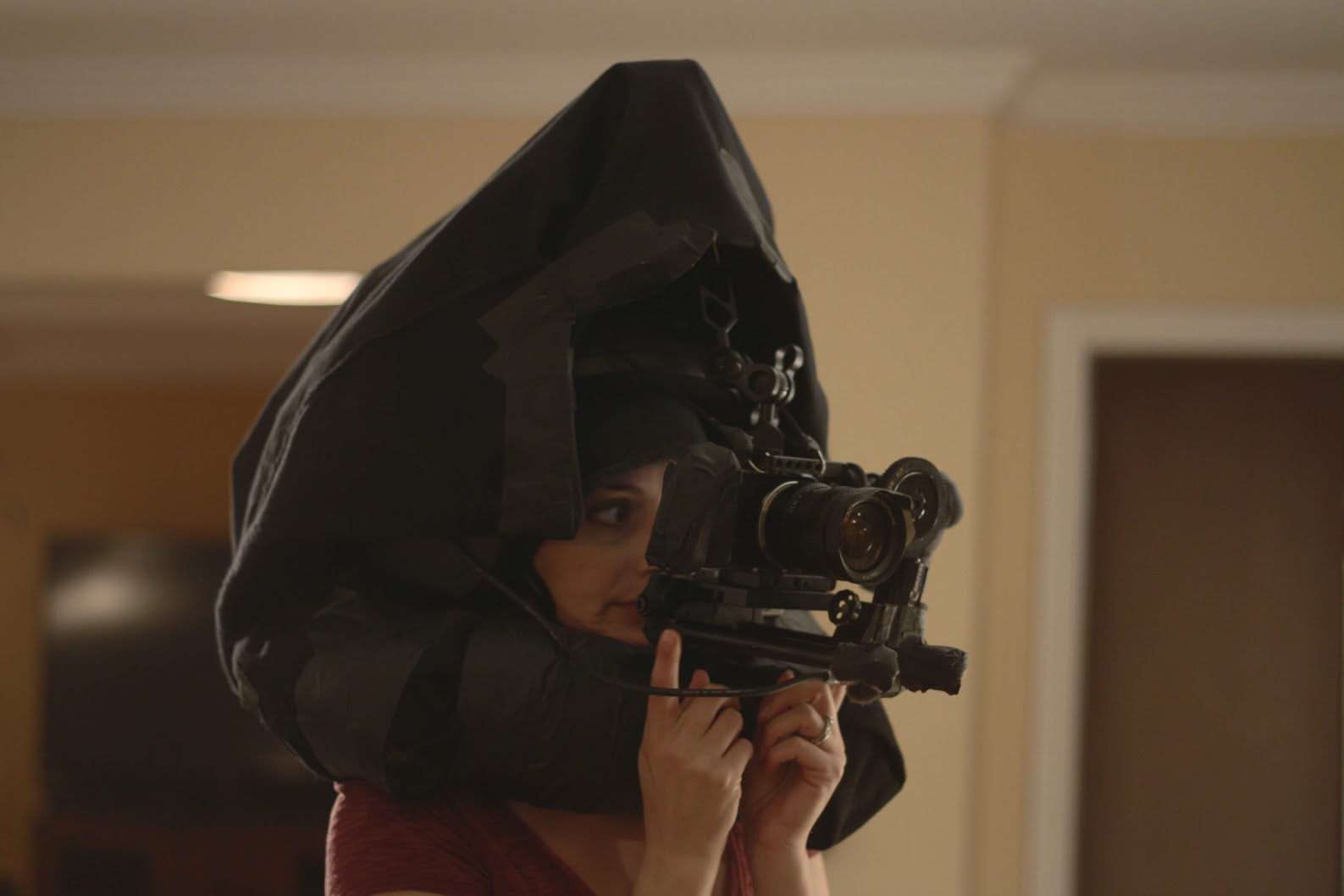
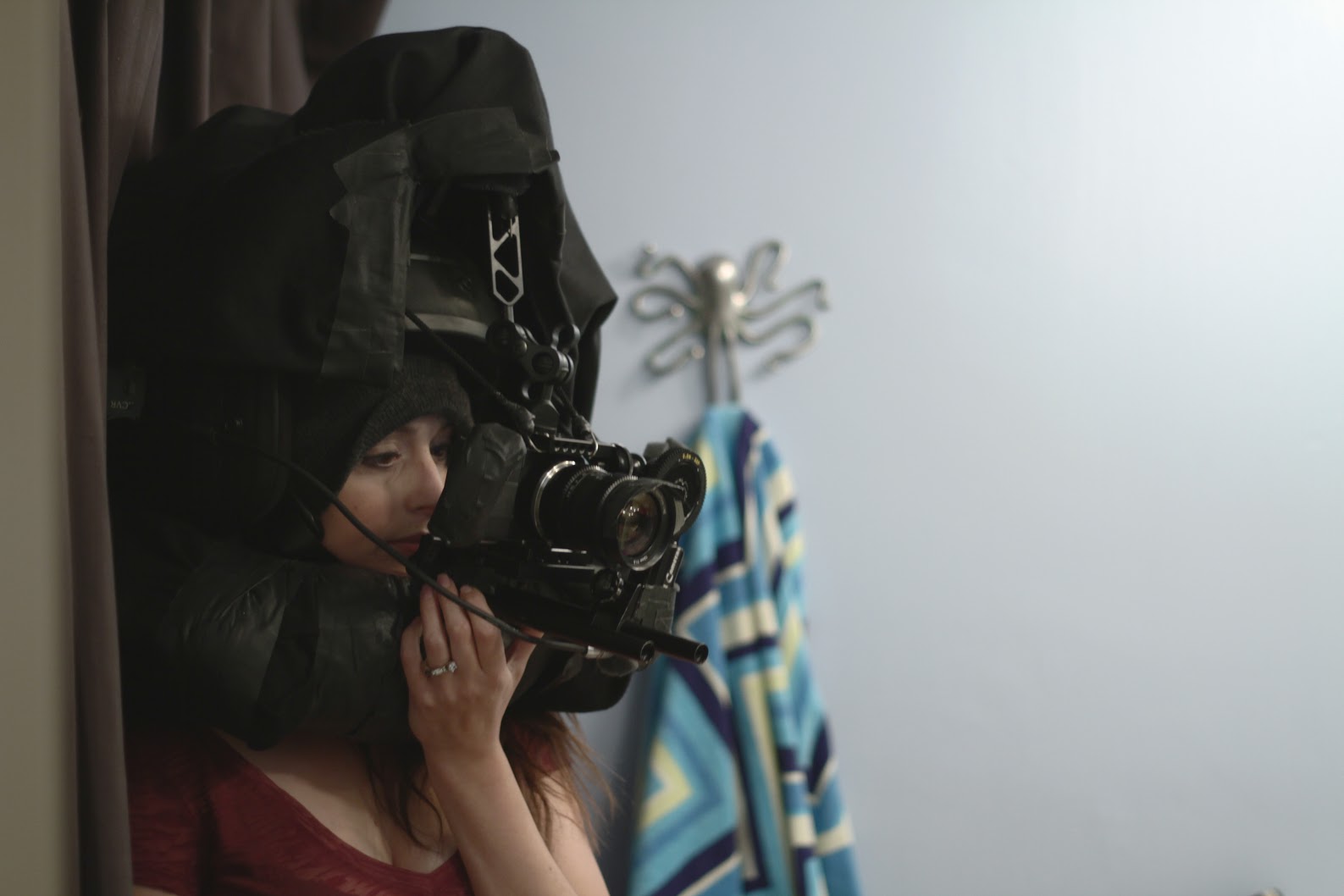
D.L: The POV helmet rig was born out of necessity. My goal was to make the POV shots feel as real as possible, and Mark’s (cinematographer) goal was to make them look as cinematic as possible. I wanted to be able to see the arms and legs and wounds of whoever’s POV we were in and allow the actors to interact directly so that their performances weren’t hindered. We decided on the POV helmet rig because the camera could hang in front of someone at eye level and they’d maintain most of their mobility.

When searching for the right camera the Blackmagic Pocket Cinema Camera absolutely nailed all three of our three main factors: Cost, weight, and quality. The camera is lighter than any DSLR I know of, which is very important when mounting it to a helmet that someone will wear while performing long five minute takes, and the image has a distinctly cinematic quality that makes it feel more like film than any DSLR (or GoPro). And last but not least, even on our shoestring budget we were able to afford two pocket cameras. For our prototype POV rig we just bought a motorcycle helmet off of Craigslist, drilled a hole, and then hung the camera from a single Israeli arm. That was enough to know that we were on to something. From there Mark personally took the rig from toaster to Terminator by attaching all kinds of gadgets and stabilization gear.

M.F.: Devin knew he wanted the film to be presented from the characters’ POVs.  He did some research and sent me some videos of POV style shooting mostly shot on DSLRs or GoPro style cameras.  He also sent me a video of a DIY helmet cam rig that mounted a Canon 5D and a small field monitor on a motorcycle helmet.  It was a very simple build and not what we needed, but it helped me get my head around what our helmet cam would need.  We didn’t need a monitor, but I knew we had to mount a camera, 15mm rods, a remote follow focus, HD video transmitter and a power source. It also had to be light-weight, balanced and durable enough to survive stunts. In a few weeks we had a working helmet cam, and our camera of choice ended up being the Blackmagic Pocket Cinema Camera. We also mounted a Bartech remote follow focus, and a Paralinx Arrow wireless transmitter.

We had to have the remote follow focus and HD video transmitter because I would need my hands to be free while I wore the helmet.  I had to play each of the characters and for the male characters I would look down at my hands and body, so I couldn’t have a hand on the lens pulling focus. We needed the Paralinx Arrow because my first AC had to pull focus off a monitor sometimes as far as 50 feet away from me as I was running around our set.  He had to have the highest quality image possible to insure perfect focus at all times.  Between the Paralinx and my Panasonic BTLH 2170 monitor, he was able to keep things very sharp.


* Any other cool DIY gadgets you all use and/or created while shooting?

D.L.: On a $65K budget pretty much everything feels DIY, but in particular, we had a few key story moments where cars pull up to the house or drive and the headlights needed to really blast our actors through the windows in order to stop them in their tracks at specific story moments. Car headlights weren’t high enough or powerful enough so our gaffer, Paul Monroe, hooked up two lights to a stand and then that stand to a track, so that the lights could roll up fast and swung around on a dime. It sells perfectly.

M.F.: The biggest advice I can give any indie filmmaker is to have a great script that is realistic to shoot.  People bite off more than they can chew and end up cheating themselves in the end.  A good story doesn’t need to be complicated or expensive to create.  The other advice I have, is get a great crew.  We had a very small crew, but every person did the work of two or three people.  I feel so lucky to have had the opportunity to work with such amazing and passionate people.


* What industry tip(s) can you share in regards to creating a successful indie film?

D.L.: It’s too early to call our film successful, although I guess getting any feature made is a near miracle, so my advice would be: Create. Go out and shoot short films, webisodes, and music videos until you have discovered your core creative force. A team of people who are talented, dependable, and a blast to work with. After that you will be able to shoot a feature for far less than you ever imagined. Just make sure you also choose the right project for your means. You couldn’t shoot The Avengers for 100K but you can make a damn good film for dinner money.


* What's next for you guys? Any other cool projects we should know about?
At the moment SSTS fills most of my horizon—I’m also editing the film as well—but my short techno-horror film The Instadamned (also shot by Mark) is currently being developed into a feature and Zak Bagans (executive producer) is in production on a very moving and harrowing documentary about the infamous “Demon House” in Gary, Indiana.

M.F.: We want to do another feature for sure.  In the meantime we are all back to our day jobs, which for me is directing and shooting television shows.  I just wrapped season 2 of KNIFE FIGHT for Esquire Network and will start season 2 of WHITE COLLAR BRAWLERS next month.


http://www.productionhub.com/blog/post/diy-tips-tricks-from-indie-filmmakers

A Filmmaking Website Not For The Faint-Of-Heart...


A Film About Making A Film About Street Art Where The Filmmaker Becomes A Street Artist Himself (You Follow?)...


Great Movies (In My Humble Opinion): CONTEMPT

Jean-Luc Godard's ode to the nature of cinema and love...


30 Tips to Help You Make Your First Zero-Budget Short Film...


1. Don't say it's unpaid. Say it's a collaboration. And don't just say it, mean it. You're collaborating together to create a piece of art out of whatever means you have.


2. Think of every single place you know that you have access to that could be a location. Think about this before the script stage. Your cousin is an office manager? Your Uncle owns a taxi? Your ex-girlfriend's new boyfriend lives in a mansion? Utilise these locations in your script/film.

3. Find creative people who will get something out of your project. Your friend is an artist? Ask if she wants to design DVD covers. Your Brother wants to be a singer? Get him to sing a song about the movie and post it on YouTube to promote the project. 

4. Related to the point above -- don't do it all yourself. Part of doing a zero-budget film is that you do need to do a lot of it yourself; but delegate! Find other creative people who want to get involved. 

5. Be confident. It's your piece of art. It doesn't have to be a masterpiece, and you don't need to be intimidated by anyone -- this is your chance to create something personal.

6. Create something personal. Write from the heart

7. Write to your budget. No explosions, no car chases, no burning down buildings. 


8. If you know people who can stage explosions, car chases and buildings burning down, then by all means use them if it'll help your story (but don't break any laws and don't kill any people, not even actors).
 

9. Don't be afraid of actors just because it's your first movie. They need the roles, otherwise they wouldn't do it! And most of them -- some of them -- are very friendly people. 


10. Cast interesting and intriguing actors. There's only so much time in a short film to tell a story; so tell some of the story through the interesting faces you present on screen. 


11. Don't hire heaps of lights and things with cables and buttons that you don't understand. Focus on telling a story. 


12. Shoot without permission. Tell people you're students, tell people you're just taking a picture, tell people you're not filming-just-pretending-to. Or my old favourite, you say, "We are thinking about doing a film so we're just coming here to test out the light and see if it's workable". 


For some reason, people will stop you from filming but they won't stop you from filming-to-see-if-it's-the-right-place-to-film. This really works!


13. Don't spend all day getting every single angle conceivable. Think about the story you're telling -- storyboard if it helps you --- think about shooting scenes creatively in ways that support your vision, rather than covering absolutely everything ten times over. 


14. Get a few takes and then move on. 


15. Start early. Don't feel bad about it. Everyone wants to make a movie so get them up early and crack on. 


16. If on day two, your actor has quit -- don't keep ringing them up, demanding they return. At the level you're at --- justified or not-- actors will go for paid work instead, or they'll think you're amateur, or they'll be lazy and stay home. Y'know what? It's happened to everyone, find a way to keep telling your story. 


17. It's not just actors. It could be anyone. If it's YOUR MOVIE, it's going to mean more to you than the others -- so you gotta do whatever you gotta do to make it happen. 


18. If someone is working exceptionally hard to help you with YOUR VISION; then treat them to something. A chocolate bar. A bunch of flowers. A new house. Whatever you can afford. These people are extremely rare. 


19. Find lovely people to work with. 


20. Don't get stressed. 


Okay, you will get stressed. But don't drag it on for hours. 


Maybe the sound guy was late. Maybe the camera is broken. Maybe the building exploded at the wrong moment. 
 

But what are you going to do? Moaning and stressing doesn't bring a solution. You need to focus on finding solutions to problems as they arise. 


Sometimes we get caught up in rehashing the same old problems. Telling each person, one-by-one, oh how badly we were let down by someone or something -- but it solves nothing! Be a pro. Move on. 


21. Don't have friends on set just to have friends on set. They'll get in the way. 


22. If you have friends helping you out on the crew --- then you need to be very careful about which friends you choose. 


Explain to them exactly what they'll be doing, and let them know precisely how boring it will be. Everyone loves the idea of working on a movie, but after three days in which they've done nothing but hold a boom pole, they get bored. And then that darn pole keeps dipping into the shot.


You need people who are committed. 


23. If you have scenes where characters are eating food -- build your lunch breaks around it, so that the actors are working and eating. It saves time and money. Don't tell the actors you're doing this, they'll get grumpy. 


24. Feed everyone well -- but keep it cheap. Try make it hot if you can. Everyone likes Pasta.
 
25. Do not fall in love with cast members or crew members, because if they fall in love with someone else during the production, your whole brain goes funny and your feet keep forgetting where the floor is. 


This is not a good state of mind for a director. 


26. Give praise! These people are giving their time for nothing; working as hard as they can -- and they're just as insecure as you are. Giving them specific and honest praise will help them, and the set will become rather pleasant and productive-- which is what you want, right? 


27. Ignore the temptation to say, "Well we're not far behind --- how about if we wrap now and pick up the rest when we finish tomorrow?"


That's a bad idea. Do it now. Ignore the tiredness. 


28. Ignore the tiredness -- you're making a movie! Have some caffeine and go go go make it happen --- yawn when no-one is looking--- then go go go again. 


29. Tell people every four minutes that the lights are hot; because they keep forgetting and keep burning their hands. We don't know why they do that but they do. 


30. Enjoy it. You're MAKING A FILM!!!!


http://www.kidinthefrontrow.com/2012/10/how-to-make-short-film-indie.html